Energy & Manufacturing in Appalachia (EMA)
This initiative provides technical assistance and business support to small and medium manufacturers and enterprises seeking to expand business, production and jobs in the energy industry.
Helping Manufacturers Grow into the Energy Supply Chains
Learn more about these supply chains with reports, events, videos and more to take advantage of market opportunities. A mini-grant of up to $10,000 is available to reimburse companies for projects that support market development opportunities.
Get Plugged In Get Your Mini-GrantEnergy DIY Tools
Self-Assessment
In 15 minutes, get a report on where you should focus your energy strategies.
Get StartedEnergy Efficient Factory Toolkit
Determine your baseline emissions and create a plan to achieve reduction goals.
Learn MoreIncentive Finder
There are millions of dollars in available grants and tax incentives. Identify which ones are the best fit with the largest ROI.
Get StartedGHG Emissions Calculator
Compute the Greenhouse Gas Emissions through your facilities and operations.
Learn MoreHelping Manufacturers Embrace Energy
Manufacturing companies also need to walk-the-talk on the net zero pathway as they expand manufacturing in these industries, and reinvest money from saved energy in business and workers. EMA helps with these initiatives through emissions reductions assessments and implementation strategies that increase efficiency and reduce production costs.
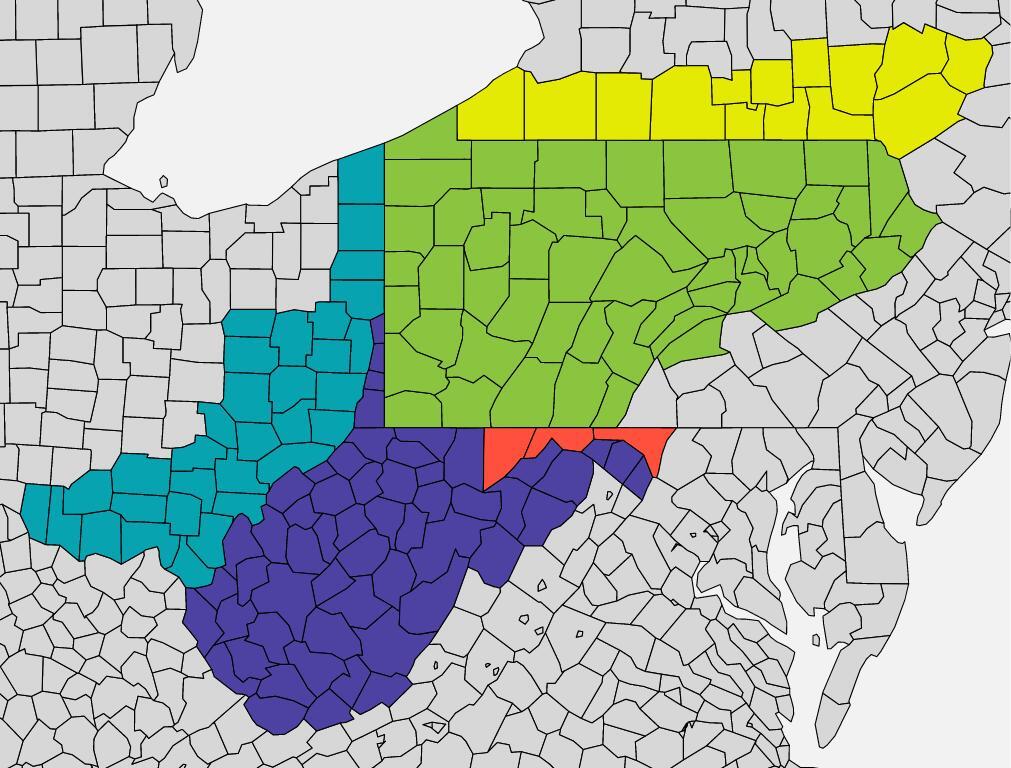
The Appalachian region of 156 counties of Maryland, New York, Ohio, Pennsylvania, and West Virginia has been central in the coal energy sector which powered American manufacturing might, and to the natural gas industry which is now a cornerstone of America’s energy independence. EMA was established to help small and medium manufacturers be a part of this Energy Economy. This program is managed by Manufacturing Extension Partnership (MEP) organizations from five Appalachian states. The activities and intended outcomes of EMA align with the National Institute of Standards and Technology (NIST) MEP and its mission to enhance the productivity and technological performance of U.S. manufacturing.
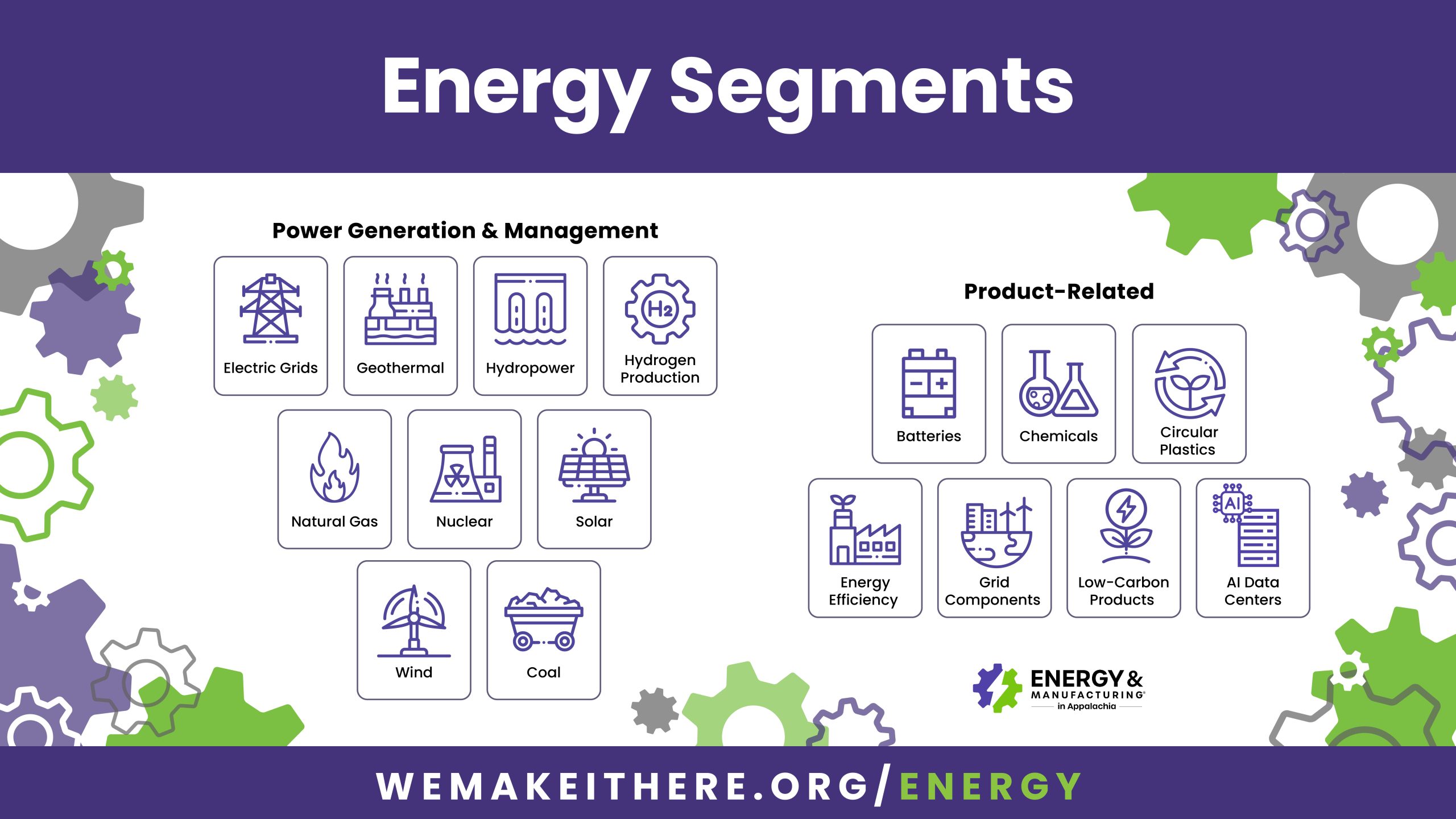
Get ConnectedThis energy economy vision builds on the competitive assets of the region and looks to create an Appalachian Decarbonization Hub with key elements that will include:
Power Generation & Management
- Electric Grids
- Geothermal
- Hydropower
- Hydrogen Production
- Natural Gas
- Nuclear
- Solar
- Wind
Product-Related
- Batteries
- Chemicals
- Circular Plastics
- Energy Efficiency
- Grid Components
- Low-Carbon Products
Connections
Manufacturers should connect with their local MEP Point of Contact to learn more about EMA opportunities:
- PENNSYLVANIA
Catalyst Connection (southwestern part of PA MEP)
Tom Reed
treed@catalystconnection.org
(412) 918-4269 - Johnstown Area Regional Industries (JARI)
Dave Grimaldi
dgrimaldi@jari.com
(814) 262-8366 - IMC (central part of PA MEP)
Dennis Gilbert
dennisg@imcpa.com
(570) 329-3200 - MANTEC (south central part of PA MEP)
Bruce Newell
bruce@mantec.org
(717) 833-6196 - MRC (central east part of PA MEP)
Shawn Furman
Shawn.Furman@mrcpa.org
(610) 737-2529 - NEPIRC (northeastern part of PA MEP)
Marla Hager
marla@nepirc.com
(570) 704-0025 - NWIRC (northwestern part of PA MEP)
Robert Zaruta
rzaruta@nwirc.org
(814) 217-6061 - OHIO
MAGNET(part of Ohio MEP)
Darlyn McDermott
dmcdermott@manufacturingsuccess.org
(330) 858-5581 - WEST VIRGINIA
WVU (and WV MEP)
David Carrick
david.carrick@mail.wvu.edu
(412) 327-9119 - MARYLAND
Maryland MEP
Michael Kelleher
mkelleher@mdmep.org
(443) 343-0085 - NEW YORK
AMT (part of New York MEP)
Carol Miller
cmiller@amt-mep.org
(607) 774-0022 x316
Funding for this initiative was provided through the following grants from the Appalachian Regional Commission (ARC):
- Manufacturing the New Energy Economy in Appalachia – ARISE Grant
- Tri-State Net Zero – POWER Grant
- ShalePOWER 2.0: Supporting Appalachian Businesses to Diversify into the Shale-Manufacturing Sectors
This initiative is targeted to the following 156 counties across five states in Appalachia:
-
- Maryland – Allegheny, Garrett, and Washington
-
- New York – Allegany, Broome, Cattaraugus, Chautauqua, Chemung, Chenango, Cortland, Delaware, Otsego, Schoharie, Schuyler, Steuben, Tioga, and Tompkins
-
- Pennsylvania – Allegheny, Armstrong, Beaver, Bedford, Blair, Bradford, Butler, Cambria, Cameron, Carbon, Centre, Clarion, Clearfield, Clinton, Columbia, Crawford, Elk, Erie, Fayette, Forest, Fulton, Greene, Huntingdon, Indiana, Jefferson, Juniata, Lackawanna, Lawrence, Luzerne, Lycoming, McKean, Mercer, Mifflin, Monroe, Montour, Northumberland, Perry, Pike, Potter, Schuylkill, Snyder, Somerset, Sullivan, Susquehanna, Tioga, Union, Venango, Warren, Washington, Wayne, Westmoreland, Wyoming
-
- Ohio – Adams, Ashtabula, Athens, Belmont, Brown, Carroll, Clermont, Columbiana, Coshocton, Gallia, Guernsey, Harrison, Highland, Hocking, Holmes, Jackson, Jefferson, Lawrence, Mahoning, Meigs, Monroe, Morgan, Muskingum, Noble, Perry, Pike, Ross, Scioto, Trumbull, Tuscarawas, Vinton, Washingtons
- West Virginia
- – Barbour, Berkeley, Boone, Braxton, Brooke, Cabell, Calhoun, Clay, Doddridge, Fayette, Gilmer, Grant, Greenbrier, Hampshire, Hancock, Hardy, Harrison, Jackson, Jefferson, Kanawha, Lewis, Lincoln, Logan, Marion, Marshall, Mason, McDowell, Mercer, Mineral, Mingo, Monongalia, Monroe, Morgan, Nicholas, Ohio, Pendleton, Pleasants, Pocahontas, Preston, Putnam, Raleigh, Randolph, Ritchie, Roane, Summers, Taylor, Tucker, Tyler, Upshur, Wayne, Webster, Wetzel, Wirt, Wood, Wyoming
Resources
Each energy segment has a supply chain of products and services needed to build and maintain a robust ecosystem. Open one of the supply chain overviews to learn about market, key players, components, and the types of manufacturers that sell to this supply chain.
CLICK HERE TO DIVE DEEPER INTO THE INDIVIDUAL ENERGY SEGMENTS.
Energy Reports: Access detailed reports on each energy segment. New reports are released every two weeks—check back regularly for the latest insights!
- Wind Report
- Natural Gas: Carbon Capture Report
- Nuclear Report
- AI Data Centers Overview Report
- Battery Storage Report
- Natural Gas: Upstream Report
- AI Data Centers: Power and Electrical Infrastructure Report
- AI Data Centers: Advanced Cooling Overview Report
- Natural Gas: Biogas & Renewable Natural Gas (RNG) Report
- Geothermal Report
- AI Data Centers: Structural Steel Report
- Solar Report
- Natural Gas: Midstream Report
- Blue Hydrogen Report
- Circular Plastics Report
- Chemical Report
- Hydropower Report
Assessments are available to allow manufacturers to identify the best strategies to achieve their unique goals. Start with this self-assessment to get an idea of the awareness and opportunities in energy. This can lead to a site assessment or other engagement tailored to company needs.
Self-Assessment – Energy Manufacturing Economy
Assess one of manufacturing’s largest expenses – electricity. Enter the electric bill information and receive information about ways to lower costs and apply for funding for efficiency projects. Click this link to open the Bill Analyzer tools.
There are several assessments and tools available to help a company obtain information and analysis about their current energy usage. Here are some programs to look at:
Energy efficiency strategies help manufacturing companies to proceed with efficient energy practices and practical cost reduction strategies. The first step is to identify the team of employees to support cost-reduction strategies. Second, establish a baseline understanding of current energy usage. Third is to identify opportunities to make changes. Fourth is to look at the driving forces for making a change – such as 1) save money with energy efficiency, 2) satisfy requirements by current or potential customers, 3) comply with regulatory standards, 4) be a good community partner. This will lead to establishing goals and actions for improvement and a way to measure progress. The EMA program developed the The Energy Efficient Factory Toolkit to walk companies through this process. Download it to start your journey or to enhance your current strategies.
Download The Energy Efficient Factory Toolkit
In addition to the The Energy Efficient Factory Toolkit, these resources can provide insight and resources for manufacturing companies:
Subcity Incentive Finder
The EMA program has contracted with Subcity to offer the Incentive Finder service at no cost (a $1,000 value). Eligible manufacturing companies will receive a personalized report from Subcity that identifies the grants and tax incentives that have the biggest ROI and greatest likelihood of success. Subcity can also assist the company to apply for the incentives for an additional fee.
—————————————————————————————————————————–
EMA Mini-Grant Program
EMA offers mini-grants of up to $10,000 to support manufacturers who engage in a technical assistance project that will assist them to: 1) engage with the energy supply chain and/or 2) implement energy cost-reduction strategies. These are reimbursement grants awarded after the project is completed to help offset some of the investment cost by the company.
Contact Us About Your Project Opportunity
—————————————————————————————————————————–
Additional Grant and Incentive Opportunities
There are additional grant and tax incentive opportunities that a company may qualify depending on various factors (location, industry, business size, ownership type, etc.) Here are some programs to look at:
Events
The Energy Efficient Factory Accelerator Training
October 9, 2026 | Catalyst Connection | 4501 Lytle Street, Building A, Pittsburgh, PA 15207
Identifying energy waste is only the beginning. This interactive accelerator workshop helps manufacturing leaders turn ideas into action with a structured plan to reduce energy consumption, lower operating costs, and improve facility performance. Leave with practical tools, baseline assessments, and an implementation roadmap you can begin using immediately to drive measurable results.
This training is in-person and all costs for manufacturing employees is paid for from a grant from the U.S. Department of Energy’s (DOE) Industrial System Energy Efficiency Development (ISEED) Collaborative Program.
Videos: Unlocking Sustainable Solutions
Explore the transformative landscape of Clean Energy Manufacturing through our on-demand video series, delving into expert insights and practical knowledge to empower sustainable practices in your operations.
Get Connected
Connecting with Energy & Manufacturing
The Energy & Manufacturing in Appalachia initiative supports small and medium-sized manufacturers (SMMs) in eligible counties to expand business, production, and jobs in energy supply chains and reduce costs through factory efficiencies.