Industry Overview & Market Opportunities
The circular plastics industry is centered around transforming the traditional model of plastic use that usually ends in the landfill into a sustainable circular economy. This involves designing plastics and plastic products to eliminate waste and pollution, to be reused, recycled, or composted, and to keep materials circulating at their highest value for as long as possible. The goal is to reduce reliance on raw materials, lower plastic pollution, minimize carbon emissions, and create long-term resource efficiency. The focus is also looking at alternatives to traditional raw materials such as fossil fuels while at the same time balancing society’s dependence and reliance on plastics for survival.
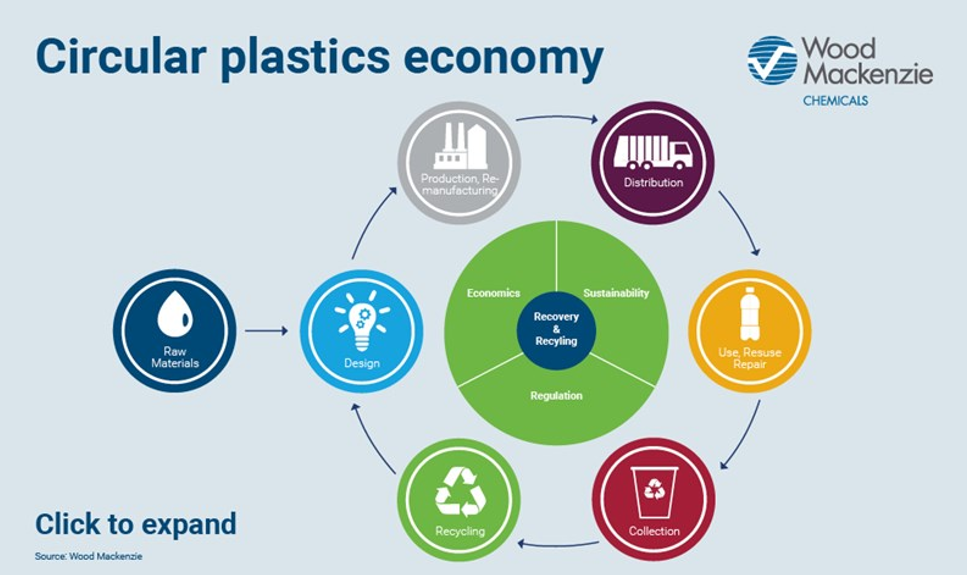
There are several key areas of focus driving the circular plastics industry:
- Elimination of unnecessary plastics – this area focuses on reducing plastic use where possible and avoiding items that are hard to recycle.
- Reuse models – promoting reusable packaging and products to reduce single-use plastics. Compared to other models, reuse can be more economically and environmentally beneficial.
- Innovation in recycling and materials technology – looking at developing plastics that are easier to recycle or compost, and advancing recycling technologies to improve mechanical, chemical, and other technologies to expand the types of plastics that can be recycled.
- Material recovery infrastructure – looking at the current recycling practices and improving collection, sorting, and processing systems to keep eligible plastics within the economy and out of the landfill.
Mechanical recycling is the dominant form of recycling, particularly for common forms of polymers like polyethylene (PE), including high density (HDPE) and low density (LDPE), which are the most common variations used in packaging. Post consumer recycled plastics play a key role in the circular plastics economy as adoption increases and advanced manufacturing progresses.
Market growth is driven by federal and state policies as well as corporate mandates and consumer preference. The global circular plastics market is poised for significant growth with some estimates projecting the market to be nearly $200 billion by 2035 from the current size of $73 billion. Advanced technologies are able to integrate a higher percentage of recycled plastics into the manufacturing process across packaging, textiles, automotive, and other sectors helping to drive growth. Innovation is the key to adoption and growth in the circular plastics industry. AI is being integrated into sorting systems to improve accuracy, efficiency, and reduce costs and contamination.
Based on some industry data, currently only 5% of products that can be recycled are recycled in the United States. In terms of percentage, this is a decrease from 2018 when an estimated 9% was recycled. This decrease also translates to less tons being recycled with estimates of 1.8 million tons currently being recycled and over 3 million tons in 2018. Some categories see higher recycling rates such as PET or HDPE plastic bottles which is nearly 30%.
Trade Associations
- Plastics Industry Association (PLASTICS) – www.plasticsindustry.org
The primary U.S. trade group representing companies across the plastics supply chain, including producers, processors, recyclers, and equipment suppliers. Strong focus on sustainability, advocacy, and supporting a transition to the circular economy. - Association of Plastic Recyclers (APR) – www.plasticsrecycling.org
An industry group dedicated to the enhancement of plastics recycling, representing recyclers and related businesses nationwide. - Institute of Scrap Recycling Industries (ISRI) – www.isri.org
Represents the full recycling industry, including plastics, and supports sustainable materials management and circular economy policy. - National Waste & Recycling Association (NWRA) – www.wasteandrecycling.org
Includes members involved in plastic recycling and supports circular economy initiatives. - Pennsylvania Recycling Markets Center (RMC) – www.pennrmc.org
Nonprofit organization working to expand markets for recycled materials (including plastics), with programs supporting business development for circular plastics solutions in PA, and outreach to manufacturers and recycled feedstock users. - Central Ohio Reuse Coalition (CORC) – www.centralohioreuse.org
A regional nonprofit network advancing reuse and circular economy solutions, especially for packaging and plastics in Central Ohio. - Ohio Materials Marketplace – www.ohio.materialsmarketplace.org
An online platform and network, supported by Ohio EPA, connecting businesses to trade and repurpose materials, including plastics, and build a circular economy in Ohio. - Circular Action Alliance (CAA) – www.circularactionalliance.org
Producer responsibility organization representing brands and packaging producers on circularity and EPR (Extended Producer Responsibility) policy in Maryland and other states. - Closed Loop Partners – www.closedlooppartners.com
Invests in and collaborates with circular plastics businesses and infrastructure across multiple states in the Northeast and U.S.
Connect. Collaborate. Power the Future.
Be part of the conversations that matter.
Return to the Energy Supply Chains page to access additional reports and information.
Return to the main Energy page for upcoming events bringing together manufacturers, suppliers, and energy leaders.
Contact us to learn more.