Industry Overview & Market Opportunities
The electrical grid is an interconnected network that delivers electricity from power generation sources to end users, spanning from large power plants to individual homes and businesses. Often referred to as the “world’s largest machine,” this complex system comprises three main components that work together to ensure reliable electricity delivery across vast distances: generation, transmission, and distribution.
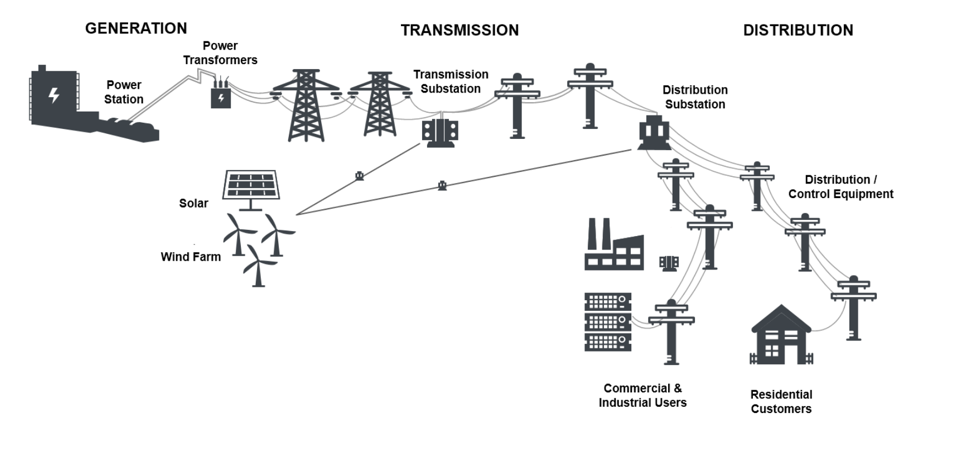
- Generation forms the foundation of the grid, where electricity is produced at power plants using various energy sources including natural gas, coal, nuclear, hydroelectric, wind, solar, and other renewable technologies. These facilities typically operate at different voltage levels, with power plants initially generating electricity at relatively low voltages.
- Transmission involves carrying bulk electricity over long distances using high-voltage transmission lines. To minimize energy losses during long-distance transport, “step-up” transformers at transmission substations increase the voltage before electricity travels along the transmission network, which can span hundreds of miles. These high-voltage lines, supported by tall metal towers, form the backbone of the grid system.
- Distribution represents the final stage, where electricity is delivered to consumers through local distribution networks. “Step-down” transformers at distribution substations reduce the high transmission voltages to safer, usable levels for homes and businesses. Distribution lines, commonly seen along residential streets and supported by wooden poles, complete the journey of electricity from generation to consumption.
The grid operates as a synchronized system where electricity generation must continuously match demand in real-time, as the system has minimal storage capacity. Sophisticated control systems and grid operators manage this delicate balance, adjusting power generation and routing electricity through multiple redundant pathways to maintain reliability and prevent cascading failures.

The grid is managed at the federal level by several agencies. The Federal Energy Regulatory Commission (FERC) serves as the primary regulatory authority overseeing interstate electricity transmission and wholesale power markets. FERC works closely with the North American Electric Reliability Corporation (NERC), which is responsible for developing and enforcing mandatory reliability standards for the bulk power system. NERC oversees nearly 400 million people across the United States, Canada, and northern Mexico, creating over 80 mandatory reliability standards that cover cybersecurity, operations, planning, and emergency preparedness.
The day to day grid operations are managed by Regional Transmission Organizations (RTOs) and Independent System Operators (ISOs). These organizations manage transmission systems across multiple states and coordinate electricity supply and demand in real-time. Currently, seven major RTOs/ISOs serve approximately two-thirds of U.S. electricity demand: PJM Interconnection, Midcontinent ISO (MISO), California ISO (CAISO), Southwest Power Pool (SPP), New York ISO (NYISO), New England ISO (ISO-NE), and the Electric Reliability Council of Texas (ERCOT). The regional operators are responsible for scheduling and dispatching power plants, operating transmission systems, and facilitating wholesale electricity markets.
- PJM Interconnection (www.pjm.com) – The largest power grid operator serving 65 million customers across 13 states and Washington D.C.
- Midcontinent ISO (MISO) (www.misoenergy.org) – Manages the grid across 15 states and Manitoba, serving over 42 million people
- California ISO (CAISO) (www.caiso.com) – Operates California’s transmission system and wholesale energy market
- Southwest Power Pool (SPP) (www.spp.org) – Manages the electric grid across 14 states in the central United States
- New York ISO (NYISO) (www.nyiso.com) – Operates wholesale power markets covering the entire state of New York
- ISO New England (www.iso-ne.com) – Manages the transmission system for all six New England states
- Electric Reliability Council of Texas (ERCOT) (www.ercot.com) – Serves as an independent system operator for approximately 90% of Texas’ electrical load, uniquely operating within a single state
While the RTOs and ISOs manage the transmission of electricity, the distribution is managed by local utilities under state control. The local distribution system operators manage the final delivery to homes and businesses.
The PJM interconnection manages approximately 183 Gigawatts (GW) of generating capacity across its territory with more than 1,400 generating units. Demand is expected to grow by 32 GW by 2030, primarily due to the growth of data centers. Additionally, the PJM is expected to see retirement of approximately 40 GW of generating capacity in that same time period.
The NYISO grid manages approximately 41 GW of generating capacity supported by 450 generating units. Demand growth in the grid by 2030 is relatively small with estimates up to 4 GW of generating capacity. However, due to state policy NYISO is expected to add approximately 15 GW of generation by renewable sources.
Trade Associations
- Power Generation
- Electric Power Supply Association (EPSA) – www.epsa.org
EPSA is the national trade association representing America’s competitive power suppliers. Its members own and operate about 150,000 megawatts of power generation capacity across U.S. regions with wholesale electricity markets managed by ISOs and RTOs such as PJM. EPSA advocates for competitive markets, innovation, and environmentally responsible power generation including natural gas, renewables, nuclear, and coal. - Energy Association of Pennsylvania (EAP) – www.energypa.org
Represents regulated electric and natural gas distribution companies, advocating for utilities serving over 8.7 million customers in Pennsylvania. - Appalachian Region Independent Power Producers Association (ARIPPA) – www.arippa.org
Independent power producers focused on coal refuse energy generation in Pennsylvania, Virginia, and West Virginia.
- Electric Power Supply Association (EPSA) – www.epsa.org
- Transmission
- North American Electric Reliability Corporation (NERC) – www.nerc.com
NERC plays a key role in overseeing grid reliability, including transmission reliability, across the U.S., Canada, and Mexico. While more focused on standards and reliability, it is central to transmission infrastructure matters. - National Association of Regulatory Utility Commissioners (NARUC) – www.naruc.org
NARUC facilitates collaboration between state utility commissions on transmission policy, planning, cost allocation, and regulatory issues. It runs the Transmission State Working Group to support state commissions in transmission expansion and evaluation. - Pennsylvania Public Utility Commission (PUC) – www.puc.pa.gov
Regulates electric transmission within Pennsylvania. - Public Utilities Commission of Ohio (PUCO) – www.puco.ohio.gov
Oversees transmission utility regulation in Ohio including grid development projects. - Maryland Public Service Commission (PSC) – www.psc.state.md.us
Regulates transmission infrastructure projects and utility operations. - New York State Public Service Commission (NYPSC) – www.dps.ny.gov
Oversees transmission planning, expansion, and policies in New York State. - West Virginia Public Service Commission (WVPSC) – www.psc.state.wv.us
Regulates electric utilities and transmission infrastructure in West Virginia.
- North American Electric Reliability Corporation (NERC) – www.nerc.com
- Distribution
- National Electrical Contractors Association (NECA) – www.necanet.org
Represents electrical contractors who install and maintain the electrical distribution systems, playing a key role in distribution infrastructure. - North American Association of Utility Distributors (NAAUD) – www.nauud.org
An association of leading regional electric utility distributors that focuses on supply chain collaboration, professional development, and emergency response in utility distribution. - National Rural Electric Cooperative Association (NRECA) – www.nreca.coop
Represents more than 900 electric cooperatives serving 42 million Americans, primarily in rural and suburban areas, focusing on distribution utility interests and community-owned systems. - National Association of Electrical Distributors (NAED) – www.naed.org
The NAED supports electrical product distributors and solution providers involved in the supply chain of distribution equipment and services.
- National Electrical Contractors Association (NECA) – www.necanet.org
Connect. Collaborate. Power the Future.
Be part of the conversations that matter.
Return to the Energy Supply Chains page to access additional reports and information.
Return to the main Energy page for upcoming events bringing together manufacturers, suppliers, and energy leaders.
Contact us to learn more.